Interface and rate
State SFP28, SFP56, QSFP28, QSFP56, QSFP-DD, or OSFP, plus the aggregate rate and the per-lane electrical rate. A 100 Gbit/s port may be 4 x 25 Gbit/s NRZ or a single-lambda PAM4 design. Those are different purchases.
NETWORK PATH · BUYER BRIEF
LinkScope Sourcing 01 is an independent sourcing partner. The desk writes a PAM4 module brief for a US buyer and asks factories to answer that same brief. A family label does not mean a plant was audited, a module is on a shelf, or a host will accept the EEPROM code.
Prepare the host platform, the lane rate, the wavelength or wavelength set, the fiber mode, the connector, the reach class, and the US destination before any quotation is compared. PAM4 uses four amplitude levels, so two bits travel in each symbol. That denser constellation leaves a smaller gap between levels than NRZ, which is why the brief has to say whether the host supplies forward error correction and which pattern the optical numbers were taken with.
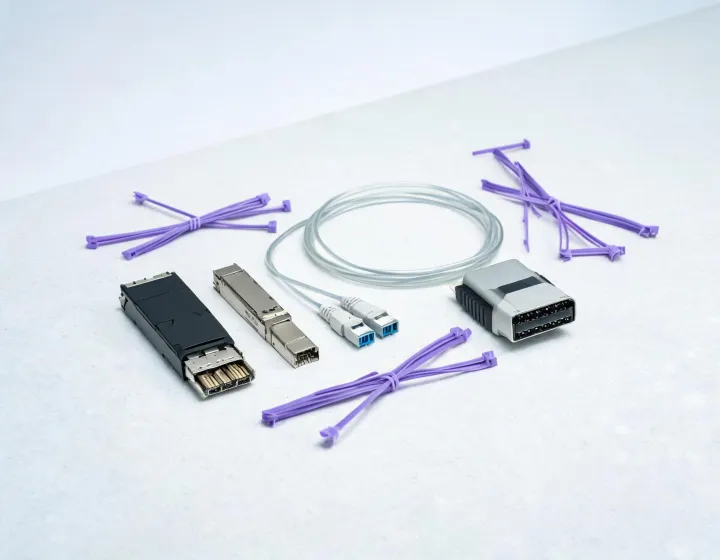
Name the switch or NIC, the port form factor, and whether the lane is 50 Gbaud PAM4 or an older NRZ electrical interface.
Record wavelength, fiber type, connector, and the reach the link design actually needs.
Ask for the datasheet, coding notes, and temperature grade tied to one manufacturer and one model.
These cards are questions, not published ratings. ITU-T fiber recommendations can frame the plant question. They do not certify the module a supplier later names. IEEE Ethernet naming can frame the rate question the same way.
State SFP28, SFP56, QSFP28, QSFP56, QSFP-DD, or OSFP, plus the aggregate rate and the per-lane electrical rate. A 100 Gbit/s port may be 4 x 25 Gbit/s NRZ or a single-lambda PAM4 design. Those are different purchases.
Multimode short-reach modules are commonly specified around 850 nm. Single-mode paths are often specified near 1310 nm or 1550 nm, or as a set of LAN-WDM wavelengths. Copy the center wavelength and the tolerance from the datasheet of the exact item.
Write OM3, OM4, OM5, or a single-mode class such as G.652.D or G.657.A1 as a plant question. Pair it with LC duplex, MPO-12, or another connector, and say whether polarity is already fixed by the installed trunk.
Reach on a brochure is a class, not a measurement of your route. Optical budget starts from transmit power minimum minus receiver sensitivity, then subtracts connector insertion loss, splice loss, and fiber attenuation at the stated wavelength.
Ask whether digital diagnostics report module temperature, supply voltage, Tx bias, transmit power, and received power. For multi-lane parts, ask whether those readings are per lane. A family photo does not show which registers the firmware exposes.
Host software may check a vendor code in the module EEPROM. Ask the supplier which hosts were exercised, at which software release, and whether a coded or uncoded part is being offered. A matching cage does not settle that question.
Keep each row as its own line. Mixing a multimode SR-class module with a single-mode FR or LR module makes the later quotation impossible to normalize. Open the inquiry options when the line is ready to name, and read the procurement brief for the evidence table.
Typical buyer questions: 850 nm, MPO or LC, OM3 versus OM4 modal bandwidth, and whether the published reach is the shorter OM3 class or the longer OM4 class. Public 100GBASE-SR4 descriptions often cite about 70 m on OM3 and about 100 m on OM4. Match those classes to the datasheet. This desk did not measure the link.
Ask for wavelength, dispersion tolerance, and the minimum transmit power. A worked check, not a product claim: if a datasheet lists Tx minimum at -6.5 dBm and receiver sensitivity at -10.3 dBm, the raw window is 3.8 dB before connectors and fiber. Record the temperature and the test pattern beside those two numbers.
Separate 50 Gbit/s SFP56, 100 Gbit/s single-lambda QSFP28, and 400 Gbit/s QSFP-DD or OSFP. Ask which FEC mode the optical specification assumes, and whether the host ASIC must provide it. Temperature grades such as 0 °C to 70 °C commercial and -40 °C to 85 °C industrial change the same optical numbers.
No. LC or MPO describes the mechanical face. The buyer still needs fiber mode, polarity, wavelength, optical budget, and a host that accepts the module identity. Ask the supplier to split a compliant offer from a deviation.
An OEM-coded part may sit closer to a platform vendor support policy. A compatible part may widen the factory list when the exact host and software release are tested. Neither label is a test report. Request the host list, the EEPROM description, and what happens if the code is rejected.
Ask whether the proposed model cites a laser class such as IEC 60825-1 Class 1, and whether any FCC equipment authorization belongs to the module or to the host system. Applicability is part of the evidence pack. This desk does not issue that evidence.
Line up quantity, currency, per-module or whole-order basis, Incoterm, freight, duties, pull-tab or heatsink accessories, coding fees, and warranty months. A lower unit printout with coding excluded is a different scope. No percentage saving is published here because this desk holds no paired quotations.
Send the product family, the host, the rate, the wavelength, the fiber plant, the quantity, the US destination, and the timing. Optional budget can name a currency and say whether the figure is per module or for the whole order. High-end, mid-range, budget, or undecided is a buyer preference, not a grade this desk has verified.
After replies arrive, bind every optical number to the named model. Then submit the procurement requirement if the brief is ready to leave your team.
QUALIFIED BUSINESS BUYERS
Compare quotations from up to 3 factories after the optical configuration is written down.
Eligibility applies to qualified business buyers and is confirmed after we review your product, quantity, destination, and sourcing requirements.